Claims case study: road to nowhere
Disputes between neighbours can easily become protracted and contentious, and this is especially true when tempers flare over the use of a right of way over someone else’s land. Arguments can be triggered when one neighbour alters their property or the way they use the land, or when a property changes hands; and as this claim case study shows, title-related issues can easily become wider disagreements.
Country roads
In 2018, we were contacted by solicitors requiring access cover for their client, who was selling a residential property in County Tyrone, Northern Ireland. Due to its remote location, access to the property from the main highway was via a private road, but there were no legal rights in place to do so. The property itself had been owned by successive members of the same family since 1904, with the seller having inherited it in 2007. The solicitors confirmed that no one in the family had ever paid for or been given permission to use the access, and that they had openly used it without any objections. Despite having strong evidence to establish prescriptive rights over the access, the solicitors wanted to ensure any buyers were protected against future challenges to its continued use. Once our underwriters had established the long history of use of the access and confirmed that the use of the property as a house would continue, we were happy to issue an access policy for £125, with a policy limit of £207,000.
A turn for the worse
Five years later, the policyholder contacted our claims team. They had been living in the property since buying it in 2018, but in January of 2023 their neighbours had begun to partially block the access route as it crossed their land. Over the next few months, the neighbours increasingly encroached on to the access immediately in front of the gates to our policyholder’s property, blocking it with tractors, trailers, and eventually a slurry tanker!
While our policyholder was still able to get in and out of their drive with a car, the obstructions prevented larger vehicles using the road, meaning that oil could not be delivered to their property and the septic tank could not be emptied. The neighbour’s intimidating and threatening behaviour escalated to such a degree that the police became involved, and it was at this stage that the policyholder got in touch with our team to try to find a legal resolution to the right of way aspect of the dispute.
Established rights
Our first step was to definitively establish that the previous owners had used this specific access route during their ownership. We knew that the current owners had been using the access up until the obstructions appeared four months previously, but to be able to claim prescriptive rights, we would need proof of twenty years of unobstructed use of this exact route. Fortunately, we were able to obtain the necessary confirmation from the previous owner’s solicitors, and so set about assessing the most appropriate legal action.
As the property was in Northern Ireland, the team appointed a Belfast-based litigation specialist with land disputes experience, who wrote to the neighbour on behalf of our policyholder, laying out the rights they had to use the access. It was the start of a long battle.
Over the next six months, discussions and negotiations continued between solicitors for both sides, trying to find a compromise and avoid court proceedings, but these showed little sign of progress. During this period, the neighbour’s irrational and unsociable behaviour continued, leading to further police involvement. They dragged their feet in negotiations and didn’t attend police-led mediation sessions, all the while continuing to block the access and intimidate the policyholders.
At this stage of the claim we were confident in the strength of our legal case and claim of prescriptive rights over the right of way. However, if we decided to instigate court proceedings, we were mindful of the fact that even if we did win the case, enforcing any legal decision, and ensuring the neighbours complied with any injunction granted, would likely still be very difficult.
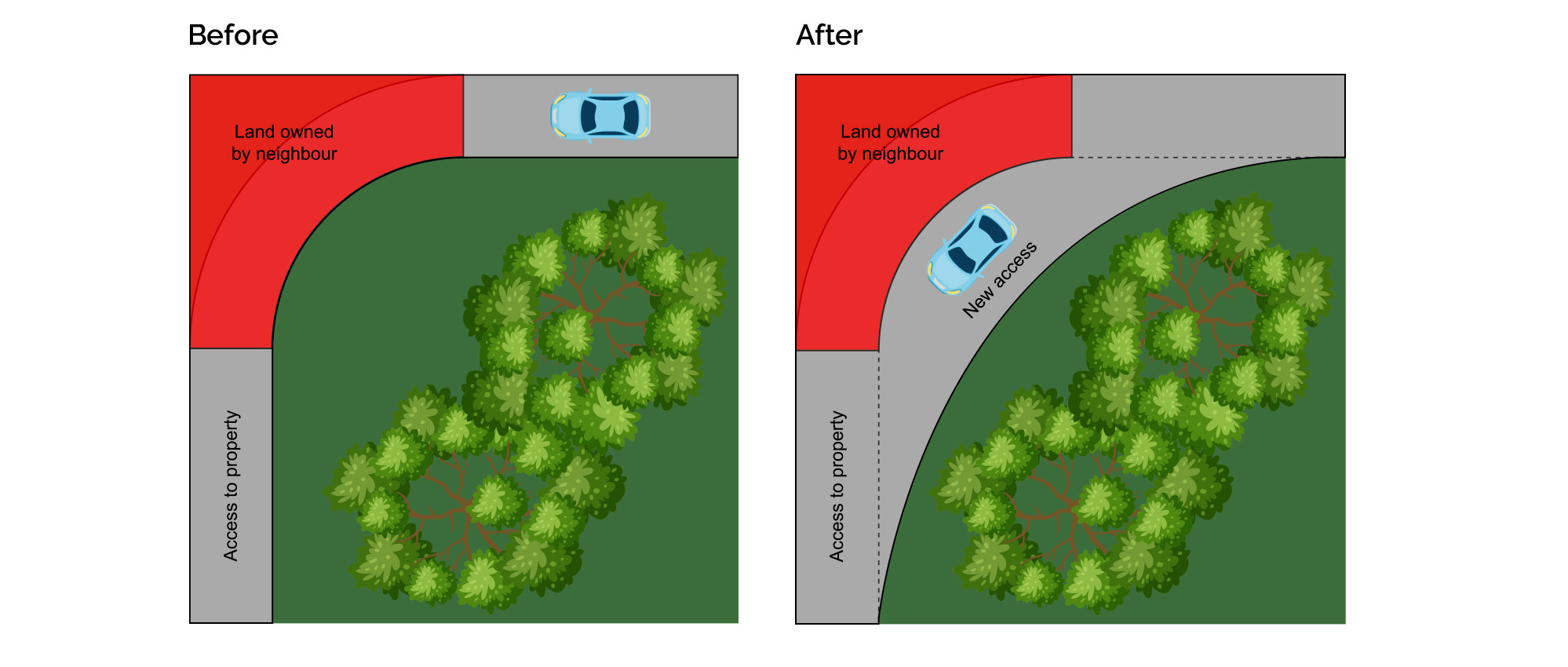
With this in mind, our claims team started exploring a more practical solution. If it were possible to move the policyholder’s driveway so that they had a new access onto the private road, one that did not go over the neighbour’s land, the team felt they could successfully resolve this aspect of the dispute.
Two-pronged approach
While we continued with the preparations for legal action against the neighbours involved with the access dispute, we briefed the policyholder on our alternative strategy. They quickly got on board with the idea and with our agreement they contacted the neighbour on the other side of their property, a farmer, about buying an area of land from them.
Happily, after several weeks of negotiations, the neighbouring farmer agreed to sell our policyholder a section of their field to create the new access way, for £5,000. Positive news at last. We quickly appointed an architect and planning consultant to draw up the plans for the new driveway and make the planning application.
Purchasing the land took some time, during which discussions continued with the neighbour over the existing access, just in case the alternative route strategy proved unsuccessful. Throughout the planning process, the neighbours continued to obstruct the original access and harass and intimidate the policyholder, which eventually resulted in an arrest in the summer. For good measure they also submitted an objection to the planning submission for the new driveway, citing concerns about flooding.
At last, in February 2025, nearly two years after we were originally notified of the access dispute by the policyholder, planning consent was granted and works started to construct the new access. This involved moving a gate, adding concrete posts, fencing, kerbs, and even having a telegraph pole moved, as well as planting 75 metres of new hedging, all on top of laying 250m2 of tarmac. Works continued throughout the summer, and by September 2025 the new driveway was completed.
A successful outcome
The total cost of the claim came to just over £59,000, which was made up of around £18,000 in legal costs, and £41,000 for the costs of purchasing and creating the alternative access, underlining the true value of the policy, which had cost £125 in 2018.
Legal indemnity claims are often a minefield, and occasionally, go beyond formal legal proceedings to something altogether more confrontational. Successfully resolving this claim required us to run two strategies in parallel. One focussed on obtaining the strongest legal argument possible ahead of any potential court proceedings; the other, practical option, which, if successful, would help side-step a difficult claim situation with an intimidating neighbour. Having our own in-house team, with their experience and sheer depth of knowledge, meant we were able to support our policyholder throughout what was an incredibly difficult and protracted situation, while working towards finding the best solution for them – providing cover that is worth much more than just writing a cheque.